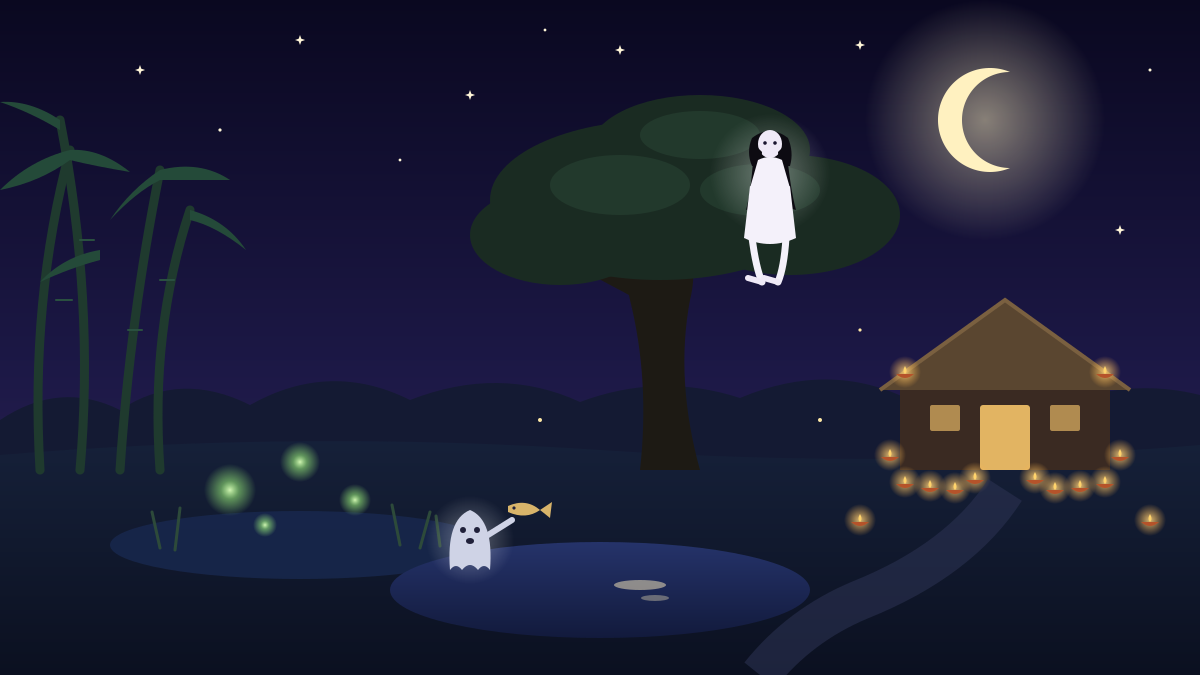
It is the night before Kali Puja. The power has gone, as it always does when you most need it, and fourteen little clay lamps are flickering in fourteen dark corners of the house.
Out by the pond, something is asking for fish. In the tamarind tree a white sari stirs, though there is no wind. And from the dark lane someone calls your name, in your mother’s voice.
Don’t answer. Not yet.
Every Bengali child grows up with a map of where the ghosts are: the bamboo grove behind the house, the old tamarind by the pond, the banyan at the edge of the field, the crumbling zamindar bari. And Bengal’s ghosts are not one spooky crowd. Each has its own backstory, its own address and its own way of being got rid of, and grandmothers were very precise about which was which.
This is a field guide to them, as the old folk tradition describes them. It is not a claim that ghosts exist. It is a record of what Bengal believed, and still half-believes on the night of Bhoot Chaturdashi.
First, how a Bengali ghost talks
You can always tell a ghost in a Bengali story by its voice. Bengali ghosts speak through the nose, nakisure, and writers show it by scattering the chandrabindu, the little moon-and-dot that marks a nasal sound, over nearly every word. A ghost never says “ami tomar ghar motkabo” (I’ll wring your neck). It says:
আঁমি তোঁমার ঘাঁড় মঁটকাঁব!
Nobody can say where the nasal voice began. It is simply how ghosts have sounded for as long as Bengali ghost stories have been written down, and every storyteller still does the voice.
The ghosts, one by one
Petni
পেত্নী
The best-known ghost in Bengal, and the one most grandmothers mean when they say “don’t go near that tree after dark”. A petni is the spirit of a woman who died with her longings unfulfilled; in many tellings, one who died unmarried.
She lives in trees, the bigger and darker the better: tamarind, sheora, banyan. She wears a white sari and leaves her long hair loose, and in many versions her feet point backwards, which is how you know her if you dare to look down. She is fond of fish, and of frightening anyone who walks under her tree at night.
- Haunts
- Tamarind, sheora and banyan trees
- Look for
- White sari, loose hair, backward-turned feet
- Folk protection
- Iron, fire and the name of Ram
Shakchunni
শাঁকচুন্নি
The name comes from shankhachurni, “she who wears the shankha”, the white conch-shell bangles of a married Bengali woman. A shakchunni is the ghost of a married woman who could not let go of her household.
She waits in the trees by ponds and bathing ghats, and her one wish is to possess a living married woman so she can run a home again. The old warning to young women not to go near the pond or under a tree at dusk with their hair loose is often told with her in mind.
- Haunts
- Trees by ponds and ghats
- Look for
- White sari, shankha on her wrists
- Wants
- A married woman’s life
Brahmadaitya
ব্রহ্মদৈত্য
The ghost of a Brahmin, and the aristocrat of Bengal’s spirit world. He lives in a bel or a peepal tree, still wears his sacred thread, the poite, and is usually described as tall, pale and dignified.
Unlike most ghosts, a brahmadaitya is often kind. In many stories he helps a poor and honest man, keeps the lesser ghosts in line, or simply wants to be left alone with his books. Annoy him, though, and he is far more powerful than any petni.
- Haunts
- Bel and peepal trees
- Look for
- White dhoti and the sacred thread
- Temper
- Usually kind. Never insult him.
Mechho Bhoot
মেছো ভূত
Mechho means “of fish”, and this ghost wants exactly one thing. He hangs about ponds, fish markets and village kitchens, and follows anyone walking home after dark with fish in their bag, calling in that nasal voice: “mãchh dẽ!” Give me the fish.
Ask a Bengali grandmother and she will tell you this is why you never carry fish home after dark. Hand it over and he leaves you in peace. Refuse, and the stories say he follows you all the way to the kitchen and eats it raw.
- Haunts
- Ponds, fish markets, kitchens
- Wants
- Fish
- How to deal with him
- Give him the fish
Skondhokata
স্কন্ধকাটা
A headless ghost, the spirit of someone whose head was cut from their body when they died. In twentieth-century tellings he is very often a man killed on the railway, which is why he is said to walk the tracks at night.
With no head he has no eyes. He gropes through the dark with both arms out, searching for his head, and grabs whatever he touches.
- Haunts
- Railway lines and lonely roads
- Look for
- No head, both arms reaching out
Nishi
নিশি
The most frightening of them all, because you never see it. Nishi comes in the dead of night and calls you by name in the voice of someone you love: your mother, a friend, your husband. Answer and follow, and the stories say you walk out of the house into the dark and are never seen again, or are found by a pond in the morning with no memory of the night.
There is one rule, and every Bengali child knows it: Nishi calls only twice. So if a voice calls your name at night, wait. A real person will call a third time.
In some tellings Nishi is not a free spirit at all but is sent by a tantrik to take someone’s life. And nishir daak, “the call of the night”, is now said of any pull you feel you cannot resist.
- Comes
- After midnight
- Sounds like
- Someone you love, calling your name
- The rule
- Never answer before the third call
Aleya
আলেয়া
Fishermen and travellers crossing the marshes of lower Bengal at night told of lights that hover and dance over the water and drift away as you come near. Follow them and they lead you deeper into the swamp, where you drown. The lights were said to be ghosts, often of drowned men, looking for company.
This is the one ghost with a scientific suspect. Lights over marshes, called will-o’-the-wisp in English, are reported all over the world, and the usual explanation is marsh gas: methane from rotting plants, set alight when a trace of phosphine ignites in the air. Nobody has reliably made one in a laboratory, so the case is not quite closed.
The aleya also gave Bengali a proverb: aleyar pichhone chhota, “chasing the aleya”, means chasing something that isn’t there.
- Haunts
- Marshes, beels and low wetland
- Look for
- Small lights floating over water
- Science says
- Probably burning marsh gas
Kanabhulo
কানাভুলো
You set out across a field you have known all your life. You walk and walk. And when dawn comes you are standing exactly where you started, having gone round in circles all night. That is the work of kanabhulo, the ghost that makes travellers lose their way.
It does no other harm; it only takes the sense of direction out of your head. Anyone who has tried to cross an unlit field on a moonless night will understand how the belief was born.
- Haunts
- Open fields and paddy at night
- Does
- Walks you in circles until dawn
Begho Bhoot
বেঘো ভূত
In the Sundarbans, where tigers still kill people, it is said that someone killed by a tiger becomes a begho bhoot. In one version of the belief the ghost is bound to the tiger and leads it to its next victim, sometimes calling out in a human voice to draw woodcutters and honey-collectors deeper into the forest.
The forest people’s protector against tiger and ghost alike is Bonbibi, the goddess of the forest, whom Hindus and Muslims of the Sundarbans both remember before they go in.
- Haunts
- The Sundarbans
- Protector
- Bonbibi, the forest goddess
Jokkho
যক্ষ
A jokkho, a yaksha, guards buried treasure. The darkest legend in this guide says that misers of old, wanting their wealth guarded forever, would shut a boy alive in the vault with it, so that his spirit would become its jokkho and let no one else touch it. Tagore built his short story “Sampatti Samarpan” around exactly this belief.
The legend lives on in an everyday phrase: jokkher dhon, a yaksha’s treasure, is something a person guards jealously and will neither use nor let anyone else use.
- Guards
- Buried treasure
- Lives on in
- The phrase “jokkher dhon”
How Bengal kept its ghosts away
Grandmothers had a remedy for everything, and most are still repeated with half a smile:
- Iron. A key, a knife or any bit of iron in your pocket was said to keep ghosts off, which is why iron was kept near a new mother and her baby.
- Light. Ghosts cannot bear the light; that is part of the logic of the fourteen lamps of Bhoot Chaturdashi.
- Never answer the first call at night. See Nishi, above.
- Don’t carry fish after dark. See Mechho Bhoot.
- The name of Ram. Say it and no ghost can touch you. Children walking past a dark tree said this rhyme under their breath:
ভূত আমার পুত, পেত্নী আমার ঝি,রাম-লক্ষ্মণ বুকে আছে, করবি আমার কী?
Bhoot Chaturdashi: the night the ghosts are invited
Once a year Bengal does something unusual: it lights the way. On Bhoot Chaturdashi, the night before Kali Puja, families light fourteen lamps in fourteen corners of the house and eat fourteen kinds of leafy greens at lunch. The lamps are for the fourteen generations of ancestors believed to come home that night, and to keep less welcome spirits out. Read about the fourteen lamps and fourteen greens, and find this year’s date with the Kali Puja timings.
It is often called Bengal’s Halloween, and the two do fall close together. But the mood is different. Halloween is costumes and fright; Bhoot Chaturdashi is about lighting a path home for the family’s own dead.
Where to meet them in books and films
Bengali writers have loved their ghosts for well over a century, and many of the best stories are funny rather than frightening:
- Trailokyanath Mukhopadhyay (1847–1919) wrote comic ghost tales in which the ghosts are every bit as foolish as the people.
- Rabindranath Tagore wrote some of the finest ghost stories in the language: “Kshudhita Pashan” (The Hungry Stones), “Monihara” and “Kankal” (The Skeleton).
- Upendrakishore Ray Chowdhury wrote “Goopy Gyne Bagha Byne”, in which the king of the ghosts grants two hopeless musicians three boons. His grandson Satyajit Ray made it into a film in 1969.
- Shirshendu Mukhopadhyay’s children’s novels, such as “Goshainbaganer Bhoot”, where a ghost is the hero’s best friend.
- Lila Majumdar’s ghost stories for children.